Difference between revisions of "Pitch"
Jump to navigation
Jump to search
| Line 5: | Line 5: | ||
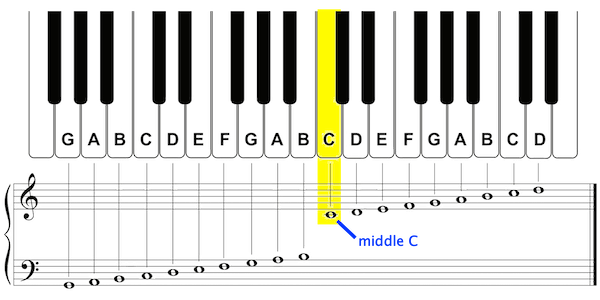
On sheet music, the pitch is alphabetical from A to G as you climb the lines and spaces - see [[note reading]]. | On sheet music, the pitch is alphabetical from A to G as you climb the lines and spaces - see [[note reading]]. | ||
| + | http://dundeepiano.co.uk/img/notes-grand-staff-sm.png | ||
| + | |||
| + | |||
| + | Sometimes extra symbols are added to change the pitch of notes: | ||
| + | http://dundeepiano.co.uk/img/note-sharp.png (#) - sharp - raise note a [[semitone]] | ||
| + | http://dundeepiano.co.uk/img/note-flat.png (b) - flat - lower note a [[semitone]] | ||
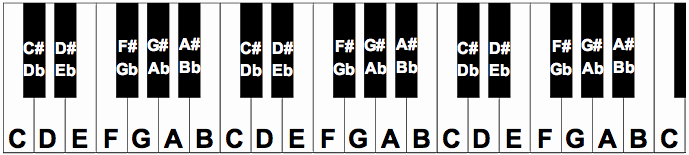
| − | http://dundeepiano.co.uk/img/ | + | http://dundeepiano.co.uk/img/piano-sharps.gif |
Revision as of 10:08, 27 August 2020
The pitch of a note is how "high" or "low" it sounds - if a mouse squeak is high - and a cow's moo is low :)
On the piano, low notes are to the left, higher to the right.
On sheet music, the pitch is alphabetical from A to G as you climb the lines and spaces - see note reading.
Sometimes extra symbols are added to change the pitch of notes:
 (#) - sharp - raise note a semitone
 (b) - flat - lower note a semitone