Difference between revisions of "Minor"
Jump to navigation
Jump to search
(Created page with "When you play minor intervals, chords or keys (versus major) - they have a semitone step to the 3rd and 6th. Some examples: * C minor 3rd = C + Eb * D min...") |
m |
||
| Line 11: | Line 11: | ||
http://dundeepiano.co.uk/img/piano-sharps.gif | http://dundeepiano.co.uk/img/piano-sharps.gif | ||
| + | |||
| + | ---- | ||
| + | |||
| + | Minor [[scales]] come in several varieties: | ||
| + | * harmonic - same up + down | ||
| + | * melodic - [[whole tone]] steps for last 2 notes in each direction | ||
| + | * natural - using notes of [[relative]] major | ||
| + | |||
| + | <youtube>https://www.youtube.com/watch?v=y2mLdtAIBHo</youtube> | ||
---- | ---- | ||
Read more: [[https://en.wikipedia.org/wiki/Major_and_minor Major and Minor]] | Read more: [[https://en.wikipedia.org/wiki/Major_and_minor Major and Minor]] | ||
Revision as of 17:24, 3 August 2020
When you play minor intervals, chords or keys (versus major) - they have a semitone step to the 3rd and 6th. Some examples:
- C minor 3rd = C + Eb
- D minor 3rd = D + F
- A minor 6th = A + F
- E flat minor 6th = Eb + Cb
- G minor chord = G + Bb + D
- B flat minor chord = Bb + Db + F
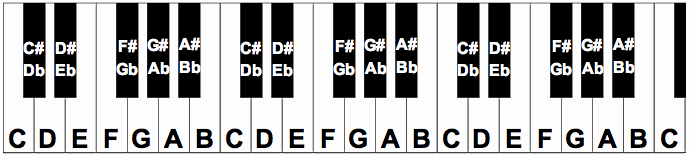
Minor scales come in several varieties:
- harmonic - same up + down
- melodic - whole tone steps for last 2 notes in each direction
- natural - using notes of relative major
Read more: [Major and Minor]